amont-fleet — a TUI for the 96-repo hook fleet
Status: built. PRs #41-#47 implement v1 and v2; scripts/propagate.sh is
gone, replaced by amont-fleet fix.
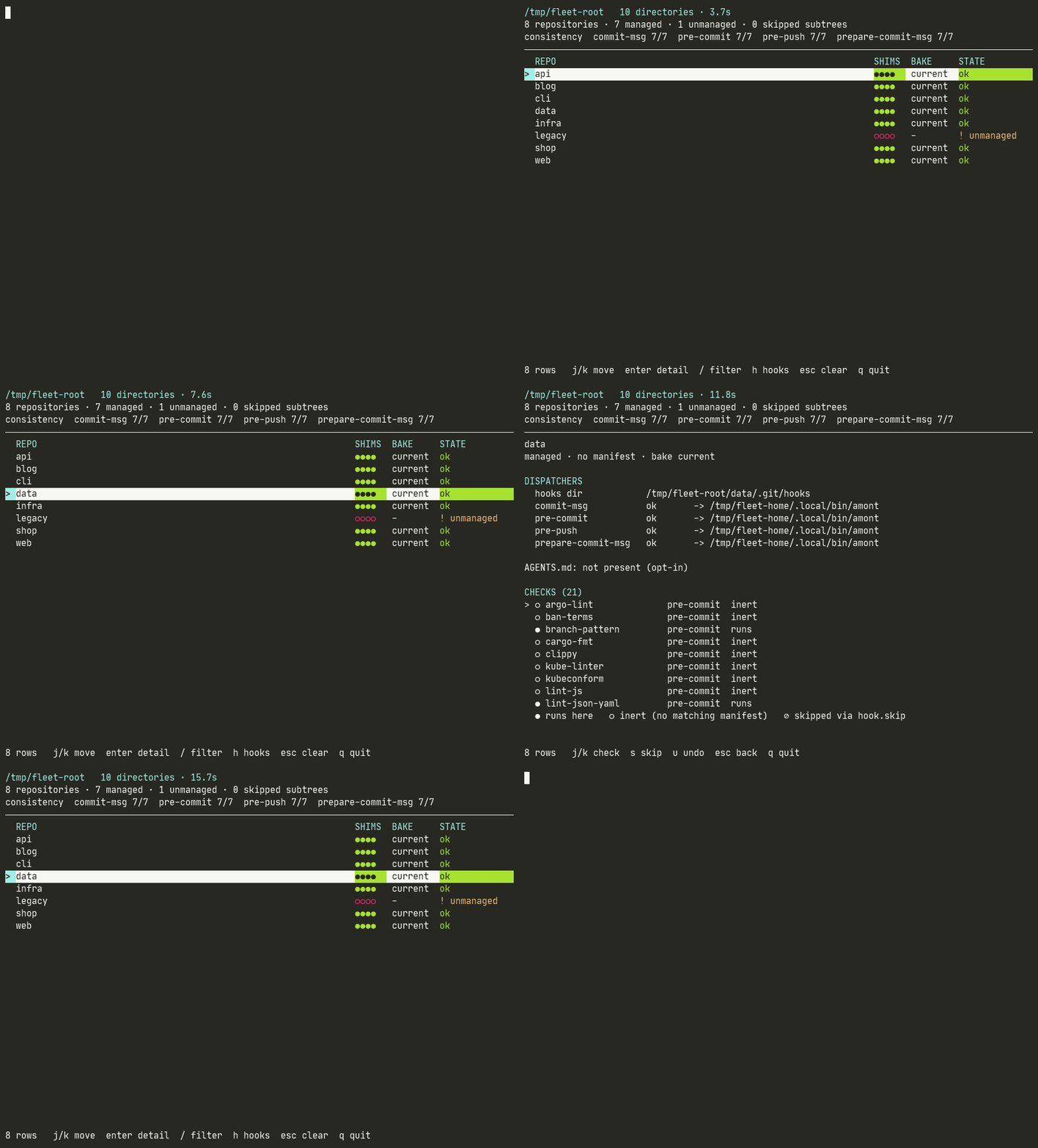
The recording is real: real repositories, shims written by the release binary,
scanned by the shipped dashboard — rebuilt any time with
assets/fleet-demo.sh.
The s toggle for hook.skip is BUILT. This paragraph called it
deliberately unbuilt for longer than it was true. s toggles the highlighted
check in the repo detail pane and u takes it back; it writes to that
repository's .git/config and refuses to touch an entry that is global or from
another config file. It is specified in
hook-skip-management.md, which is also where the
one genuine gap is recorded — there is no way to write a FLEET-WIDE skip, and a
loop over 96 local writes is not one.
It was specified as a safety feature rather than an ergonomic one, back when
hook.skip matched by SUBSTRING and hook.skip = e silently disabled all 20
checks. Matching is exact now: a value names a check by its full id, its
trigger, or its short name, and e reaches nothing. The friction the original
design carried — typing a check's name whenever a skip reached more than one —
went with the rule that made it necessary.
Unbuilt, and named rather than half-built: the : command palette, r
(rescan), ? (a key sheet), and f (fix from inside the TUI). f is
deliberate rather than pending: the dry-run/--apply split on the fix CLI
already enforces the property f was designed to give, and does it without a
modal confirmation. See Interaction model.
Why this exists
scripts/propagate.sh prints a text summary. That summary has misled its author
twice, on the same day:
- It reported 192 removals per hook name across 96 repos that hold one copy each. Two overlapping loop conditions were both claiming the same files. The number is arithmetically impossible, and it still read as plausible.
- A consistency sweep reported
0 copies / 0 distinctfor every hook. The-maxdepthwas wrong, so it matched nothing. Zero findings and a broken check produce identical output.
Both are the same failure: a scalar with no denominator, printed with the same confidence whether it measured everything or nothing. Neither is fixed by writing the script more carefully — the next one will make a third version of it. It is fixed by rendering the fleet as a grid you can look at, where "this column is empty because nothing was scanned" cannot look like "this column is empty because everything is clean".
That is the entire justification. If the dashboard does not make those two states visually distinct, it has failed and should not be built.
Non-goals
- Not part of the commit path. The hook binary stays dependency-free; see
"Packaging". A TUI in
pre-commitwould break GUI clients, CI, and piped output, and would seize the alternate screen during a commit. - Not a wrapper around the old migration scripts. The scanner, previewer,
and fixer are Rust code.
scripts/propagate.shis historical reference only and should disappear once the Rust path can prove the same removals/writes. - Not a git client. No staging, committing, diffing.
lazygitandtigexist and are better at it. - Not a linter runner. It reports on hook installation and configuration, never on the content of your code.
- Not a remote/CI dashboard. Local
.git/hooksstate only.gh dashcovers the remote side.
Prior art worth stealing from
| Project | What to take |
|---|---|
| k9s | Resource table as the primary object; / to filter, : for a command palette; a context-sensitive hotkey footer that changes with the selected row. |
| lazygit | Contextual keymap always visible; panels that own their own keys; ? for a full sheet. |
| gh-dash | The closest analogue — many remote items, sectioned, with per-row status glyphs and a detail pane. |
| broot | Incremental fuzzy filter that narrows as you type, with the match count always shown. |
| btop / bottom | Dense status rendering that stays legible at small widths. |
| helix | Selection → action ordering, and which-key style discoverability after a prefix. |
| delta | Restraint. Colour carries meaning, never decoration. |
Design principles, and where they come from
Overview first, zoom and filter, then details on demand. Shneiderman's
visual information-seeking mantra (The Eyes Have It, 1996) is the literal
structure of this tool: a fleet summary band, a filterable repo table, a detail
pane on Enter. Do not invert it — no screen should open on a single repo.
Visibility of system status (Nielsen heuristic 1). A fleet scan takes ~8s
(2.9s to enumerate 98 .git directories, 4.9s to hash 96 shims). That is well
past the ~400ms Doherty threshold at which interaction stops feeling immediate,
so the scan MUST stream: rows appear as they are discovered, with a live
scanned N/98 counter. A spinner over a blank screen is not acceptable.
Recognition over recall (Nielsen heuristic 6). The 20 check names are not memorable. Anything the user must type — a check name, a repo path — is offered as a filterable list first.
Every count carries its denominator. This is the local rule that follows
directly from the two failures above. Never render 0 drifted; render
0 drifted / 96 scanned. A table with no rows renders as an explicit
diagnostic state, never as an empty success.
Preattentive encoding, redundantly. Colour and position are processed
pre-attentively (Ware, Information Visualization), which is what makes a grid
scannable at all. But roughly 8% of men have red-green colour vision deficiency,
so state is encoded twice — glyph and colour — and never by colour alone.
NO_COLOR must produce a fully usable screen.
Data-ink ratio (Tufte). No box-drawing around every cell, no gradients, no progress bars where a number is clearer. Chrome competes with the data for the same 80 columns.
Data model
One row per repository. Collected read-only; the dashboard never writes without an explicit action.
FleetScan {
  root               : PathBuf
  depth              : usize
  git_dirs_found     : usize
  hook_dirs_seen     : usize
  managed_seen       : usize
  unmanaged_seen     : usize
  unreadable         : Vec<PathBuf>
  hooks_outside_seen : usize      // repos whose hooks resolve somewhere we will not touch
  excluded_dirs      : usize
  dirs_visited       : usize      // how much of the tree was actually walked
  repos              : Vec<Repo>
}

Repo {
  path              : PathBuf        // displayed repo-relative to the scan root
  managed           : bool           // ≥1 shim dispatches to the binary
  shims             : Vec<ShimState> // one per git-invoked hook, in DISPATCHERS order
  baked             : BakeState      // which binary path the shims point at
  stale_ours        : Vec<String>    // OUR old shims that are no longer shipped
  foreign_subs      : Vec<String>    // hand-written pre-commit-* / pre-push-* sub-hooks
  hook_pkgjson      : bool           // a vestigial hooks/package.json from the node era
  languages         : Vec<String>    // manifests at the repo root — DISPLAY ONLY
  applicable        : Vec<String>    // checks that would ever fire here, from each Scope
  skips             : Vec<SkipEntry> // hook.skip, resolved: what it hits and where it came from
  severities        : Vec<SeverityOverride>  // amont.severity.*, and which one git applies
  declared          : Vec<DeclaredCheck>     // this repo's own amont.conf checks
  trusted           : Option<bool>   // None when there is no manifest at all
  agents_md         : AgentsMdState  // UpToDate | Missing | Drifted | Malformed
  aval_hook         : AvalHook       // { state, ignored: Vec<String> } — see below
  hooks_dir         : HooksDir       // where the hooks are, and whether we may touch them
  shares_hooks_with : Option<PathBuf> // a repo already seen that owns this hooks dir
}

SkipEntry        { value, scope: Local|Global|Other{origin}, suppresses: Vec<&str> }
SeverityOverride { check, value, level, scope, effective: bool }
DeclaredCheck    { name, stage, state: Usable{severity, exts} | unusable }

ShimState = Ok            // installed bytes match the expected baked template
          | Drifted       // present, readable text, not the expected baked template
          | Missing
          | Symlink{target}    // a link — writing here would rewrite something else
          | Unreadable{why}    // a binary, a directory, a permissions error, a hard link
AvalHookState = NoCorpus  // no .adr.yaml — not applicable, and nothing was spawned
              | NoAval    // a corpus, and no `aval` on PATH to judge it with
              | Current   // `aval hook install --check` exited 0
              | Stale     // …exited 1: the hook is behind the installed aval
              | Unknown{why}   // aval answered something it did not promise
BakeState = Current       // == installed binary path
          | Stale(path)   // points somewhere else — the GUI-client failure mode
          | Unbaked       // __AMONT_BIN__ placeholder intact
          | Mixed         // shims disagree with each other
HooksDir  = In{path}      // inside the repo's worktree, or its git common dir
          | Outside{path} // reported, never created, never written to
          | Unknown{why}  // git would not say — not a state to guess out of

FixPlan {
  repo      : PathBuf
  repo_abs  : PathBuf
  intent    : "repair" | "activate"
  hooks     : HooksDir
  refuse    : Vec<Refusal> // suppresses the WHOLE repo
  warn      : Vec<Warning> // printed; suppresses NOTHING
  remove    : Vec<Removal>
  write     : Vec<WriteShim>
  write_agents_md   : Option<WriteAgentsMd>    // --agents-md only
  install_aval_hook : Option<InstallAvalHook>  // --aval-hook only; runs aval, renders nothing
}

Refusal = unmanaged | unreadable_hooks | tracked{path}
        | tracked_unknown{path, why}      // git could not answer — never read as "no"
        | foreign_hook{names} | agents_md_malformed{path} | unbakeable_binary{binary}
        | hooks_dir_outside_repo{path} | hooks_dir_unknown{why}
Warning = unrecognized_sub_hook{path}     // a hook we did not write. NOT deleted.
        | hooks_dir_outside_repo{path}
        | aval_hook_ignored{paths}        // .gitignore drops the session hook. NOT edited.
        | aval_hook_unjudged{why}         // --aval-hook asked, no aval (or an odd answer)
Four of these fields deserve a sentence, because each exists to make something that was invisible visible:
languagesis display only, andapplicableis the real answer. Language detection used to double as "would a check fire here", which made it a fourth copy of a rule that lives in each check'sScope.applicablenow evaluates those scopes against the repo's tracked files;languagesis a column a human reads.skipsisVec<SkipEntry>, notVec<String>. Bare strings hid both halves of what a reader needs: a value need not be a check id (a trigger silences fifteen), and oncegit config --get-allhas merged local and global they are indistinguishable.severitiesexists because a downgrade leaves no trace on screen. A skipped check is announced on every commit; a check downgraded towarnruns, prints its failure, and lets the commit through, so a repository that enforces nothing reads exactly like one that enforces everything.effectivematters too —--get-regexplists every entry while the dispatcher asks--getand takes the last, so listing both as authoritative reported a downgrade git does not apply.declaredandtrustedare the manifest. A repo could be running a command on every commit that no column mentioned; andtrusted: None(there is no manifest) must read differently fromSome(false)(it declared something and that something is not running).
Two channels, and why a warning is not a weak refusal
A refusal suppresses the whole repository: a half-applied fix is how a repo
ends up with both pre-commit-ruff.zsh and pre-commit-ruff, running ruff
twice. A warning prints and changes nothing about what gets done — a
stranger's pre-push-mine.sh must not block repairing five broken dispatchers
in the same directory.
Folding the two together forces a choice between "say nothing" and "do nothing",
and this tool has been on both sides of it. hooks_dir_outside_repo is the one
condition on both channels, deliberately: the warning names the directory so
somebody can go and look at their core.hooksPath, the refusal is what stops
the write.
foreign_subs is REPORTED, not removed
install and fix --apply used to delete every .git/hooks file matching
pre-commit-* / pre-push-* that did not carry our marker, in repositories
they had never touched, reported only as a number. That was inherited wholesale
from a one-time migration sweep in scripts/propagate.sh (see
git show 90b0d30^:scripts/propagate.sh, around lines 82-87) and then pinned as
golden by tests/parity.rs.
They are now Warning::UnrecognizedSubHook and are left exactly where they are.
--remove-unrecognized puts them back on the removal list, and is deliberately
not spelled --remove-stale: "stale" means stale_ours, which IS ours and is
still removed by default, and reusing that word for other people's files is
what would get somebody to type it casually.
hooks_dir and shares_hooks_with
hooks_dir exists because a scanned repository's core.hooksPath may be an
absolute path anywhere on the disk, and activation used to create_dir_all it
and write five 0o755 files into it. The fleet now refuses anything that does not
resolve inside the repository's own worktree or its git common directory.
Note the deliberate asymmetry: per-repo amont install keeps honouring its
own repository's core.hooksPath, absolute or not — you are standing in that
repository and configured it yourself. The fleet refuses, because it is walking
ninety-six repositories it did not configure.
shares_hooks_with exists because a submodule's and a linked worktree's hooks
live in the superproject/main repo. Both now appear in repos (their .git is a
FILE, which the walk used to skip outright, making every submodule on the machine
invisible), so one hooks directory is reachable from two rows. The first
repository seen in the walk's sorted order owns it; the others plan nothing and
display as covered-by.
languages matters because a check that never fires is not the same as a check
that is broken: pre-commit-clippy in a Python repo is correctly inert. The
dashboard must distinguish inert from failing, or it will manufacture 90
false problems out of pre-commit-cargo-fmt.
Shim comparison is against the rendered template for the intended binary path,
not the raw tracked template. A correctly baked shim must never be reported as
drifted merely because __AMONT_BIN__ was replaced.
Screen 1 — Fleet overview (default)
┌ amont fleet ──────────────────── scanning 98/98 · 8.1s ── /Users/me/Developer ┐
│ 96 managed · 2 unmanaged (skipped) · 384 shims · 20 checks                       │
│ consistency  commit-msg 96/1 ✓   pre-commit 96/1 ✓   pre-push 96/1 ✓             │
│              prepare-commit-msg 96/1 ✓          ← copies/distinct blobs          │
├─────────────────────────────────────────────────────────────────────────────────┤
│   REPO                       SHIMS  BAKE     LANG      SKIPS  WARN  STATE        │
│ ▸ Perso/homelab              ●●●●   current  k8s js    –      –     ✓ ok         │
│   Perso/application-landscape ●●●●  current  js        –      –     ✓ ok         │
│   Perso/git-templates        ●●●●   current  rust      –      –     ✓ ok         │
│   Perso/trade-agents         ●●●○   current  python    –      –     ✗ missing 1  │
│   Perso/frontjutsu/mvp       ●●●●   stale    js        2      1     ! stale bake │
│   Volkswagen/pos-fr-services ●●●●   current  js        –      –     ✓ ok         │
│   …                                                                              │
├─────────────────────────────────────────────────────────────────────────────────┤
│ 96 rows · 0 filtered   ↑↓ move  ⏎ detail  / filter  : command  h hooks  ? help   │
└─────────────────────────────────────────────────────────────────────────────────┘
- The consistency band is the headline, because
copies/distinctis the one number that actually proves fleet health, and it is the number the text script got wrong. It is alwaysN/M, never a bare adjective. SHIMSis five glyphs, one per dispatcher, in fixed order.●ok,◐drifted,○missing,!a symlink,?unreadable. Position encodes which hook without spending a column on its name.!and?are deliberately OFF the ●◐○ scale: those three run from healthy to absent, and a dispatcher that is a link to a tracked file is not "somewhat installed" — writing there rewrites the other file, and it must not read as a milder◐.STATEis a redundant text summary of the same information, so the screen survivesNO_COLORand CVD. It also carries the two states that are not about the shims at all:covered by <path>(a linked worktree or submodule whose hooks another row owns) and! hooks elsewhere(acore.hooksPathwe will not follow), both of which would otherwise read as! unmanagedand send somebody looking for a missing install.- A repository whose dispatchers are SYMLINKS no longer counts as
managed, even when the link points at one of our own shims. That is the intended trade:fixreports it instead of writing through the link. DECLcounts the checks a repository declares inamont.conf, and reads2!1when one of those lines cannot be parsed — a check somebody committed that has never once run.2and2!1describing the same repository is the distinction the column exists for.WARNcounts only the override git would actually APPLY.--get-regexplists every configured entry, but the dispatcher asks--get, which returns the last — so a localblockbeats a globalwarn. Counting every entry made the column report a downgrade that never happens; the shadowed entry is still shown in the detail pane, markedoverridden, because somebody wrote it. A trustedamont.confcontributes rows too — its skips and severity lines appear with originamont.conf, folded into the same ladder the dispatcher uses (policy above global, below local), so a policywarna local config re-blocks is shown but not counted.SKIPSandWARNare deliberately two columns, not one total. A skipped check does not run; a downgraded one runs, prints its failure, and lets the commit through. Summing them would hide the second — which is the one that looks like enforcement and is not.WARNcounts only overrides that actually weaken something: an explicitblock, a misspelt check name and an unrecognised value all change nothing, and inflating the count with them is how a column stops being read. The detail pane names all three.BYPASSis not folded intoWARNfor the same reason: a downgrade is a policy statement about the repository, a bypass is an event that happened. It counts unverified commits — commits carrying no record their commit-time gate ran — read from the runtime's local ledger through the runtime's own parser. The count is a floor once the runtime compacts the ledger; the tint follows recency (an event in the last 30 days), because three dodges this month and three from two years ago must not paint alike. A rate needs a denominator (commits over the same window,rev-list --countat scan time); that is deliberately v-next rather than half-implemented here.
The empty state, which is the point
├─────────────────────────────────────────────────────────────────────────────────┤
│                                                                                 │
│   No repositories found under /Users/me/Dev                                     │
│                                                                                 │
│   Scanned 0 directories in 0.1s. This is a SCAN FAILURE, not a clean fleet.     │
│   • is --root correct?        (currently: /Users/me/Dev)                        │
│   • is --depth deep enough?   (currently: 6)                                    │
│                                                                                 │
An empty table must never render as a calm empty list. Zero scanned is stated as a failure in words. This single screen is the reason the tool exists.
Screen 2 — Repo detail (Enter)
┌ Perso/trade-agents ─────────────────────────────────────────────────────────────┐
│ /Users/me/Developer/Perso/trade-agents          python · managed · bake current │
├─────────────────────────────────────────────────────────────────────────────────┤
│ DISPATCHERS                                                                     │
│   ✓ commit-msg           blob 7914a85  matches template                         │
│   ✓ pre-commit           blob 7914a85  matches template                         │
│   ✓ pre-push             blob 7914a85  matches template                         │
│   ✗ prepare-commit-msg   MISSING       → `amont fleet fix`                    │
│                                                                                 │
│ CHECKS (20)                        pre-commit                                   │
│   ● ban-terms      ● merge-conflict   ● package-lock   ● usual-name              │
│   ● lint-json-yaml ● yamllint         ○ lint-js        ○ prettier                │
│   ● ruff           ● pyright          ○ cargo-fmt      ○ clippy                  │
│   ○ argo-lint      ○ kube-linter      ○ kubeconform                             │
│                                    pre-push                                     │
│   ● branch-protect ● branch-pattern   ● pull-rebase    ○ run-tests-js            │
│   ○ cargo-test                                                                  │
│                                                                                 │
│   ● will run here   ○ inert (no matching manifest)   ⊘ skipped via hook.skip     │
├─────────────────────────────────────────────────────────────────────────────────┤
│ ⏎ back  s toggle skip  f fix this repo  o open  y copy path  ? help              │
└─────────────────────────────────────────────────────────────────────────────────┘
The ● / ○ / ⊘ distinction is the important one. A Python repo showing ○ clippy is healthy; the same glyph must never be used for "broken". Three states,
three glyphs, three words in the legend — no colour required to read it.
The detail pane also carries, above the dispatchers, the resolved hooks dir
(always, not only when something is wrong with it — a reader who cannot see the
directory cannot tell a repo we declined to touch from one that had nothing to
do) and, when set, shares hooks covered by <path>.
Below them, leftovers are TWO blocks, not one:
│ LEFTOVERS OF OURS (nothing dispatches these — fix removes them)                 │
│   pre-commit-ruff                                                               │
│                                                                                 │
│ NOT OURS (left alone — nothing dispatches these either)                         │
│   pre-push-branch-protect.sh                                                    │
They shared a heading for two releases while fix --apply silently deleted the
second list. Same word, opposite fates.
Screen 3 — Hook-centric view (h)
Transposes the matrix. Answers "where does pre-commit-pyright actually apply,
run, get skipped, or stay inert?" Checks are no longer installed as per-repo
files; the view is about runtime applicability, not file presence.
│   CHECK                 APPLICABLE  ACTIVE   SKIPPED   INERT                    │
│ ▸ pre-commit-ban-terms      96        96        0        0                      │
│   pre-commit-ruff           11        11        0       85                      │
│   pre-commit-pyright        11        11        0       85                      │
│   pre-commit-clippy          3         3        0       93                      │
│   pre-push-run-tests-js     41        39        2       55                      │
Rows sum across; APPLICABLE = ACTIVE + SKIPPED. A row where APPLICABLE is 0
is highlighted, because a check that can never fire anywhere is either dead or
misconfigured — and that is invisible in today's text output.
Interaction model
Modal and keyboard-first, following k9s and helix. No mouse dependency; mouse scroll may be supported but nothing is mouse-only.
The keys that exist. This table was aspirational and is now a list of what
tui.rs actually binds; the footer of each screen shows the same set.
| Key | Where | Action |
|---|---|---|
↑↓ j k | everywhere | move selection |
Enter | fleet | detail of the selected repo |
Esc | everywhere | back, or clear the filter |
/ then text, Backspace | fleet | incremental filter — match count always shown |
h | fleet | toggle fleet ↔ hook-centric view |
s | detail | toggle hook.skip for the highlighted check |
u | detail | take that toggle back |
f | fleet, detail | show the repair for the selected repo — what would be removed and written |
y / Enter | sync preview | carry that repair out |
Esc | sync preview | discard it, nothing written |
q | everywhere | quit — including during a scan |
And the ones that do not, removed from this table rather than left as
promises: : (a command palette), r (rescan), ? (a key sheet). All three
are still reasonable ideas.
Destructive actions are diff-first. In the TUI, f never writes: it builds
the same FixPlan the CLI's fix preview prints, for the one selected
repository, and puts it on screen — removals, writes, the shims that are
already current, and anything worth noting. y applies exactly that value, and
apply re-verifies every refusal at the moment of writing, so a tree that
changed between the preview and the keypress is refused rather than acted on.
f uses the safe defaults only — Repair, no AGENTS.md, nothing deleted
that this tool did not write; the two opt-in flags below stay CLI-only because
each is a materially bigger action than restoring four untracked shims. A
repository that is not ours, or whose hooks are somewhere we will not touch, is
refused in place with a one-line reason, no modal. On the command line the same
split is enforced by the verb rather than a prompt:
amont-fleet fix                    # DRY RUN — prints the plan, writes nothing
amont-fleet fix --apply            # carries it out
amont-fleet install                # implies applying; named after intent
amont-fleet fix --apply --agents-md          # opt in, per invocation
amont-fleet fix --apply --aval-hook          # opt in, per invocation
amont-fleet fix --apply --remove-unrecognized
fix with no --apply is the preview, built from the same typed FixPlan the
apply consumes, so the preview cannot drift from the act. The TUI's f / y
pair is the same property in a different shape: y is only bound while a plan
is on screen, and it applies that plan and no other, so there is no keystroke
that skips the preview and "yes" can only ever mean what was last shown.
install is the one verb that implies --apply, because requiring both would
be ceremony over an unambiguous intent; it has no TUI equivalent, since
adopting a repository is not a repair.
Three flags are opt-in per invocation and never bundled into a plain
--apply: --agents-md, which writes into a tracked file; --aval-hook,
which does the same for another tool's tracked files; and
--remove-unrecognized, which deletes pre-commit-* / pre-push-* files this
tool did not write. The last is spelled that way rather than --remove-stale
on purpose — "stale" means our own retired shims, which are removed by default
and are a different thing entirely. --binary <path> chooses what the shims are
baked to point at, defaulting to $HOME/.local/bin/amont.
--aval-hook keeps aval's session hook
current across every repository that keeps an .adr.yaml. aval hook install
writes .claude/hooks/aval-heads.sh and a SessionStart entry in
.claude/settings.json, so an agent session opens with the decision heads and
adopted rules in front of it; the script's bytes are its version, and every
aval release that changes it leaves every corpus behind until somebody re-runs
the command there. The fleet does not render that script — the template is
aval's, and a copy here would be a second way to be stale. It runs aval hook install --check per corpus and reads the exit code (0 current, 1 behind),
plans aval hook install for the stale ones, and re-asks at the moment of
writing. A repository without .adr.yaml is never asked; one with a corpus and
no aval on PATH is not judged — a warning, not "current", because a
missing binary is exactly how "up to date" would be faked by silence. What git
would do with the files is reported alongside from git check-ignore: a
.gitignore that excludes .claude/ wholesale makes the hook work for whoever
ran the command and ship to nobody, and the fleet names the negations to add
(.claude/* then !.claude/settings.json, !.claude/hooks/,
.claude/hooks/*, !.claude/hooks/aval-heads.sh) rather than editing an
ignore file it does not own.
Given make install has destroyed tracked source twice in this repo's
history, the dashboard's write path gets the same fail-closed treatment: it
refuses any path git reports as tracked — and any path git will not answer
about, which is a distinct state (tracked_unknown) and not a "no". fatal: detected dubious ownership is what git says about every repository owned by
another uid, which is every repository inside a container bind mount, and a
guard that reads that as "untracked" fails open in exactly the environment where
the user cannot see what happened.
Every write and every remove — in fix, in install, and in uninstall — goes
through amont_runtime::hookfile, the single owner of "is this ours, and may
we touch it?". It never follows a symlink, never treats an unreadable file as
absent, and stages each write to a sibling temporary that is renamed into
place, so replacing a link is the only thing that can happen and writing through
one is not a code path that exists.
Performance
- Stream, never batch. Enumerate
.gitdirectories first (2.9s) and paint rows immediately inscanningstate; hash shims on a worker pool and update rows in place. Sorting is stable so rows do not jump under the cursor. - Never block the UI thread. A 16ms frame budget; scanning runs on threads
and posts results over a channel.
qmust work during a scan. - The plain commands stream too.
scan,fix,installanduninstallshare the walk, and the same rule applies to them: a live status line on stderr carrying elapsed time, the two counts, and the path being looked at right now. It is the path that matters when a scan stalls — a frozen count says something is slow, and only the path says what. Gated on stderr being a terminal, and erased before the report prints, so a piped or redirected run emits exactly the bytes it always did. - Bounded work. Respect
--depth(default 6) and skipnode_modules,target,.venv,vendor— the same exclusions the existing sweep uses. - No cache in v1. An 8s scan does not justify a cache and its invalidation bugs. Revisit only if the fleet grows past a few hundred repos.
Accessibility and degradation
NO_COLOR(andTERM=dumb) → glyph-and-text rendering, fully usable.- CVD-safe: state never encoded by colour alone; every colour is paired with a distinct glyph and a word in the legend.
- Narrow terminals: below 100 columns drop
LANG,SKIPS,WARN,DECLandBYPASStogether; below 60, fall back to a single-column list. Never horizontal scrolling. - Screen readers do not meaningfully work with TUIs. The accessible path is
therefore
amont fleet --json, emitting the full data model for scripting and assistive tooling. This is a first-class output, not a debug flag, and the TUI is a renderer over it.
Packaging
A cargo workspace, so the commit path keeps its posture:
crates/
  amont-runtime/ # registry + hook logic. std-only.
  amont/         # the hook binary. ZERO external dependencies.
  amont-fleet/   # scanner, fixer, JSON, TUI. ratatui + crossterm.
amont must not gain an external dependency, directly or transitively; that
property is the reason the Rust migration happened at all. The TUI is a separate
artifact that a developer opts into, and make install continues to install
only the hook binary.
Extracting amont-runtime has an independent benefit: there is currently no
lib target, which is why cargo test --lib fails outright. Unit tests for hook
logic would move into a library where they belong, without letting TUI
dependencies into the commit path.
Version plan
v1 — Rust-native fleet truth
Build the minimum useful tool, but build it in the final architecture:
- Workspace split into
amont-runtime,amont, andamont-fleet. - Rust scanner for
--rootand--depth, with explicit counters for found git dirs, seen hook dirs, managed/unmanaged repos, unreadable paths, and excluded directories. - Rust shim inspection: five dispatcher states, baked path state, stale managed
files, foreign sub-hooks, vestigial hook
package.json, languages, skips. amont-fleet --json, emittingFleetScan.- Default TUI overview and repo detail views.
- Rust
amont-fleet fix [repo|--all] --dry-run, producing aFixPlan. Shipped inverted, and better: dry run is the DEFAULT and--applyis the flag, so the writing form is the one you have to type. - Rust apply path for that exact
FixPlan, with a second confirmation in the TUI and tracked-file refusal before any remove/write. The tracked-file refusal shipped. The TUI confirmation did not, because there is nof— the CLI split does the same job; see Interaction model. - Tests for broken root, too-shallow depth, baked-template comparison, managed detection, stale file classification, tracked-file refusal, and dry-run/apply parity.
v1 may omit the hook-centric view and skip toggling if they slow down the first
usable release. It may not shell out to propagate.sh.
v2 — operational dashboard
Add the workflows that make the grid more than a safer propagation report:
- Hook-centric view (
h) over applicability, active, skipped, and inert counts. - Detail drilldown from a check row to the matching repos.
stoggle forhook.skip, backed by Rustgit configcalls and a preview of the exact config mutation.- Command palette entries for
:root,:depth,:rescan,:export json, and:fix. - Optional activity signal after measuring cost: last commit date or another cheap recency marker, never on the initial UI thread.
- Remove
scripts/propagate.shonce v1/v2 fix coverage has replaced its last practical use.
Shipped alongside — amont-fleet gates
Not in either list above, because the question it answers was not one this
design knew to ask. The scan says whether a repository's hooks are
installed; it cannot say whether the checks they run still check anything.
A fleet audit on 2026-09-19 found four mechanisms that had silently stopped
— a lockfile audit run one directory too high, a govulncheck built with an
old Go, uv with no .venv, an npm that timed out — all of them green,
all of them fast.
amont-fleet gates reads the run record the hooks keep in each repository's
refs/notes/amont-gate and reports, per repository and gate: runs in the
window, pass/fail, median and last duration, last-run age, and the flags
no-op suspect, flaky and stale. Same shape as the rest of this tool —
read-only, --json as a first-class output, every threshold on the command
line, and an honest abstention (insufficient history (2 verdicts)) rather
than a guess. The statistics belong to amont_runtime::gate_evidence; this
crate contributes the Serialize coat and the table, for the same reason
downgrades defers to the runtime's parser.
It is a CLI table today and deliberately not a TUI screen: the overview grid is one row per repository, and this is one row per gate per repository with a sentence attached to each flag. A screen for it is worth designing once somebody has read the table for a few weeks — see gate evidence.
Decisions
- Scan root. Use a CLI flag in v1. Add persistent config only after using the tool enough to know where it belongs.
- Fix path. Native Rust. Do not shell out to
propagate.sh. - Delivery target. Build through v2. v1 is the first shippable slice, not the end state.
- Activity signal. Sorting by last-commit date would surface "the repos you
actually use are drifted" — but it costs a
git logper repo. Measure first.
Delivery plan
Seven PRs. The ordering is not cosmetic: the destructive code is written only after a differential has proven the model it destroys with, and the TUI is last because it is the least risky part and the least useful if the data beneath it is wrong.
1. Workspace split, zero behaviour change. amont-runtime (lib,
std-only) and amont (bin), no features. The proof is that all 174 tests
pass UNCHANGED, plus a differential running every hook over the same fixtures
before and after, comparing bytes and exit codes — the technique that caught
four bugs during the zsh port. This PR must also land the zero-dependency CI
guard (cargo tree for amont shows nothing external); without it the
packaging rule is a comment, and ratatui arrives transitively three PRs later.
Highest mechanical risk, no feature value, therefore alone.
2. Scanner and --json, no TUI. FleetScan with every counter. This
already replaces the ad-hoc find/hash-object pipelines that misled twice, so
it is useful before any UI exists. Tests: broken root, too-shallow depth,
excluded directories counted, unreadable paths recorded.
3. Shim classification. Expected shim = the embedded template rendered for the intended binary path. The trap is symmetrical and silent in both directions: compare against the RAW template and all 96 repos report drifted, so the tool cries wolf and gets ignored; compare too loosely and real drift is never seen. Both directions get a test.
4. FixPlan dry-run and the parity gate. A differential over all 96 repos:
the Rust plan against propagate.sh --dry-run, normalised and compared. This is
what earns the right to delete the shell script, and it is the long pole of the
project — not the TUI.
5. Apply path, fail closed. Refuses tracked paths, unmanaged repos and unreadable hook directories. Dry-run/apply parity plus idempotence: applying twice must produce an empty second plan. Written only after 4 proves the model.
6. TUI v1 — overview and detail. ratatui's TestBackend renders into an
assertable buffer, so the success criterion becomes an automated test: a
deliberately broken scan must render SCAN FAILURE. Same for NO_COLOR and the
60/100-column fallbacks. A success criterion nobody can run is a wish.
7. v2, then remove propagate.sh. Hook-centric view, s skip toggle,
command palette. The script is deleted once 4 and 5 have replaced its last
practical use.
Two details settled before starting
- Invocation is
amont-fleet, notamont fleet. A subcommand would require the hook binary to locate and exec the TUI binary, coupling the commit path to a tool it must never know about. The screens'amont fleetprompt is shorthand for the separate binary. - Templates are embedded with
include_str!against the workspace root, so the tool reports correctly from any directory rather than only inside a checkout. All five dispatcher templates are currently ONE blob, so this is a single embedded string, not five.
Success criteria
The tool is worth building only if, on a deliberately broken scan (wrong root, wrong depth), the screen says scan failure rather than showing a clean, empty, green fleet. Everything else is convenience.